It is a fact that we spend the vast majority of our time in indoor spaces, where the air is up to ten times more polluted than outdoors. A pleasant living space depends on a number of influences: room size, light, furniture, home textiles, floor coverings, heating, ventilation, humidity and, last but not least, emissions of volatile substances from materials in the space.
People in general are not aware of the harmfulness of the ingredients in various products, or only become interested when health problems that cannot be clearly identified arise.
In terms of substances that are allowed to enter formulations, interior wall paints have been regulated since 2007, when the European REACH Regulation (Registration, Evaluation, Authorisation and Restriction of Chemicals) came into force and began to define, control and restrict the use of substances in terms of their hazardous effects on the health of living beings and the environment. Consequently, in 2008 the CLP Regulation (Classification, Labelling and Packaging of substances and mixtures) came into force, which controls the placing of hazardous substances on the market, meaning that hazardous substances and preparations containing hazardous substances must be correctly classified, labelled and packaged.
Directive (EU) 2004/42/CE came into force in 2007 as well, restricting the use of volatile organic compounds (VOC) in consumer products. All of the above has considerably improved the safety of interior wall paints, which are used, in addition to by professional painters, by many people who paint their own walls and ceilings in their homes.
In recent years, there has also been a substantial increase in concern about interior air quality (AIQ). Interior air quality control is not yet regulated at the level of the European Community, but there are many national regulations with slightly different definitions of hazardous volatile substances and their maximum allowed concentrations. One of the first European countries to issue an interior air quality regulation was France (DEVL1101903D).
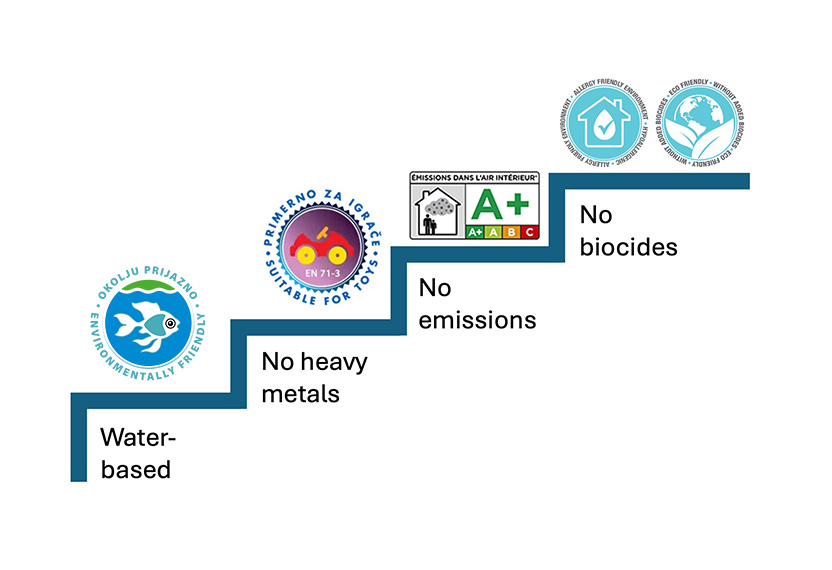
In 2011, in France, a VOC decree on the classification and labeling of all building coatings incorporated into indoor spaces, floor and wall coatings, as well as paints and lacquers, came into force, into so-called emission classes based on emission measurements in accordance with European standard EN ISO 16000. The products are grouped into 4 classes according to the emissions of defined volatile substances: A+, A, B and C.
| Class |
C |
B |
A |
A+ |
| TVOC (total VOC) /µgm-3 |
>2000 |
<2000 |
<1500 |
<1000 |
| Formaldehyde |
>120 |
<120 |
<60 |
<10 |
| Acetaldehyde |
>400 |
<400 |
<300 |
<200 |
| ... |
|
|
|
|
| Styrene |
>500 |
<500 |
<350 |
<250 |
Partial illustration od allowed concentrations of some hazardous volatile substances defined in the French VOC and their classification according to the total content of volatile organic compounds.