Enabling an easy marking process with preformed SIGNOFORM thermoplastic
Highly trafficked roads, highways, bike lanes and paths require durable markings to organise the traffic or to provide guidance and information for drivers and pedestrians. The use of classic road marking paints leads to high maintenance costs. Therefore, local and state institutions demanded alternative solutions. In recent years, thermoplastics have become increasingly popular for painting lines and markings on paved surfaces due to their special properties and cost-saving and simple application process.
A low workload and minimal lead times, combined with high durability, make preformed thermoplastics one of the most popular road marking materials in public areas, municipalities and cities. They can be applied without major barrier and preparation measures and the treated surface can be used again unrestrictedly in the shortest possible time.
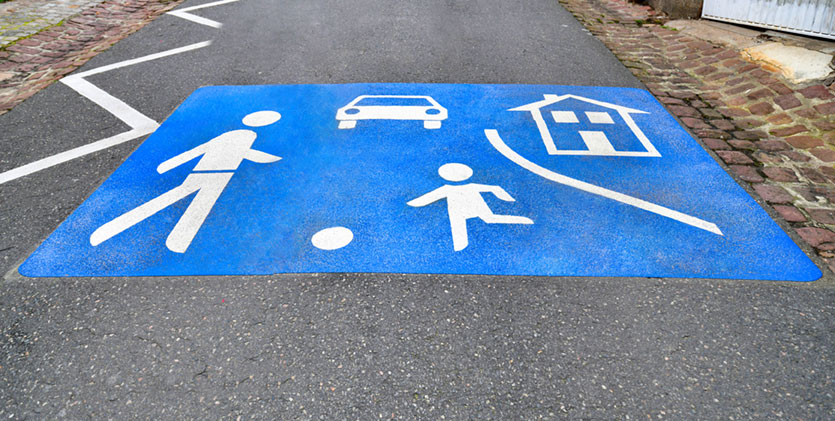
Compared to classic thermoplastics, the preformed version comes in premade (preformed) symbols and shapes. In the KANSAI HELIOS product assortment of SIGNOFORM, including lines, arrows, letters, numbers and many other special signs, are available in 24 RAL colours. The material is supplied in large pieces, which are put together like a giant puzzle.
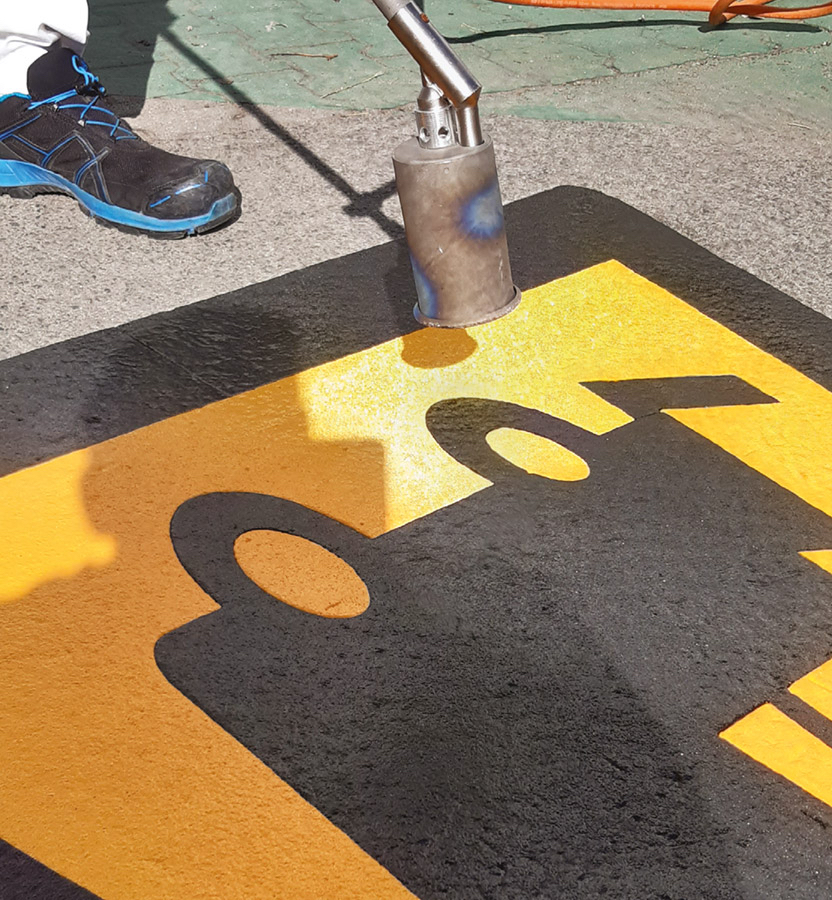
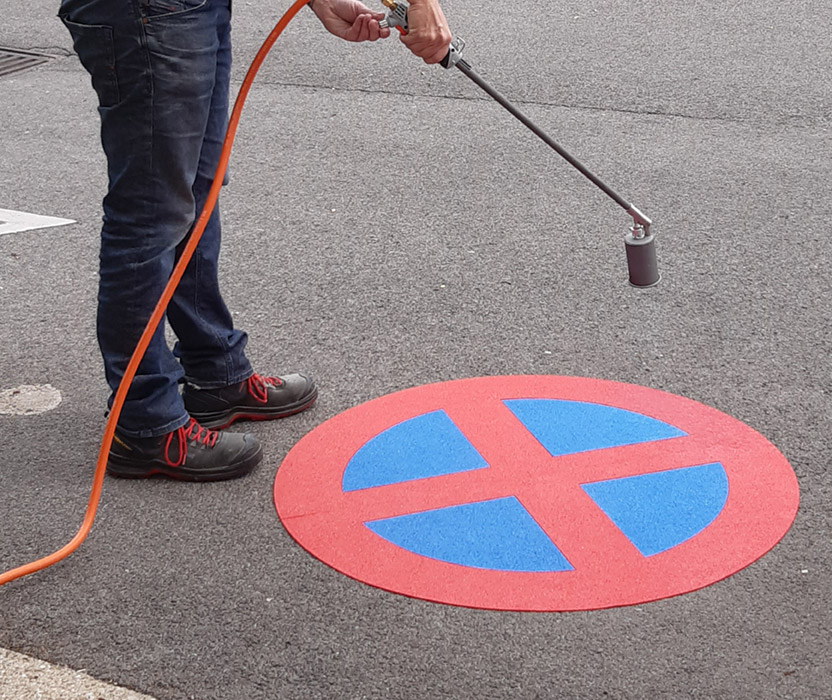
For the application process, neither expensive stencils nor special machinery or equipment are required. Instead, the material is simply flamed with a gas burner on a solid substrate, such as asphalt, concrete or natural pavement or cobblestone pavement. However, due to adhesion, the use of a primer is recommended for the application on concrete. The application is completely odour-free. After preheating the substrate, the thermoplastic pieces are applied and scarfed at approximately 220 °C and at least 4 bar gas pressure. This causes the material to melt and simmer until it completely bonds with the substrate. The addition of reflective glass beads or sprinkling agent makes the marking even more visible in all light and weather conditions. The curing process is temperature-dependent and takes approximately 10 minutes at an outside temperature of 26 °C.
Preformed thermoplastics are not only used for new marking areas but also for the renovation of already marked areas. Due to the gentle demarking process the removal of an old or damaged marking will not destroy the pavement. The surface is slightly heated and the sign is then scraped off manually. Thus, the floor covering does not have to be milled off and therefore no additional machinery is needed.
Safety with a touch of colour
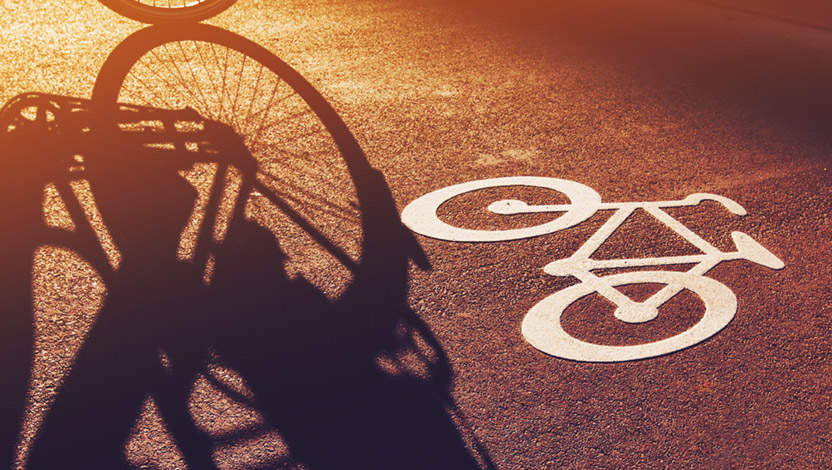
Especially in public areas, diverse, colourful and smart marking solutions are requested. In addition to classic traffic floor markings, decorative markings with colourful patterns and surfaces are very popular. In combination with roll plastics, SIGNOFORM makes coloured parking spaces or cycle paths possible. Thus, due to a cheerful variety of colours, recreational facilities, sports facilities as well as kindergardens become places where people like to spend time.
Higher durability and resistance
Preformed thermoplastics, like SIGNOFORM, are highly durable pavement markings. SIGNOFORM was designed to deliver excellent levels of retroreflective performance. Compared to conventional 1-component road marking material, the durability of preformed thermoplastic is four times higher. SIGNOFORM is also certified by BAST P7, which guarantees a service life of 4 million tire passes. The product has a luminance coefficient in retroreflection of >150 mcd/m² and an SRT value of >45. Due to these values it provides increased safety in wet and dark conditions, as well as good skid resistance for pedestrians, cyclists and motor vehicles.
With preformed thermoplastics customers benefit from a premium, out-of-the-box road marking solution, which is, however, extremely simple. By taking SIGNOFORM into its road marking material assortment, KANSAI HELIOS makes a sustainable contribution to road safety and further strengthens reliable and strategic partnerships with authorities, public institutions and municipalities.