When treating interior and exterior wall surfaces, the general rule is that each coating is only as good as the substrate on which it is applied. However, contractors/users often question whether it is necessary to follow the recommended procedure for preparing the substrate, mainly due to higher costs of the materials and work. To reduce costs, they usually skip the impregnation or use methods that are no longer recommended by paint manufacturers.
Impact of impregnation on the substrate
Impregnations are used to prepare interior and façade wall surfaces. They are recommended for new, unpainted, as well as for old, paintedwall surfaces. On new, unpainted wall surfaces, impregnation unifies and reduces the absorbency of the entire surface, which achieves an even colour tone and lower paint consumption.
There are additional reasons to use impregnation on old wall surfaces:
the presence of several old coatings that challenge the new coating’s adhesion,
reduced binding (chalking) on the surface, causing poorer adhesion of the new coating,
unequal quality of the entire surface due to repaired cracks,
levelling using materials that do not match the base…
Impregnation strengthens the substrate, binds old coatings together and to the substrate, unifies and reduces absorbency and improves the adhesion of new coatings. It also reduces paint consumption and ensures an even colour tone. Its role in adhesion is particularly important when applying high-quality coatings to a substrate that was previously painted with coatings of lower quality. The importance of impregnation for the adhesion of a coating to an old, chalked substrate is shown in Image 1.
Image 1: Coating adhesion test on an impregnated and non-impregnated substrate
Impregnation types according to appearance, function and composition
There are generally three types of impregnations:
transparent, water-based,
transparent, solvent-based,
pigmented, water-based.
The main component of an impregnation is always the binder, which is dissolved in a solvent or is in the form of an aqueous dispersion. With aqueous coatings, impregnations typically have similar compositions to paints. There are acrylic, silicone and silicate impregnations, which correspond to acrylic, silicone and silicate dispersion paints. With solvents, synthetic resin is dissolved in an organic solvent.
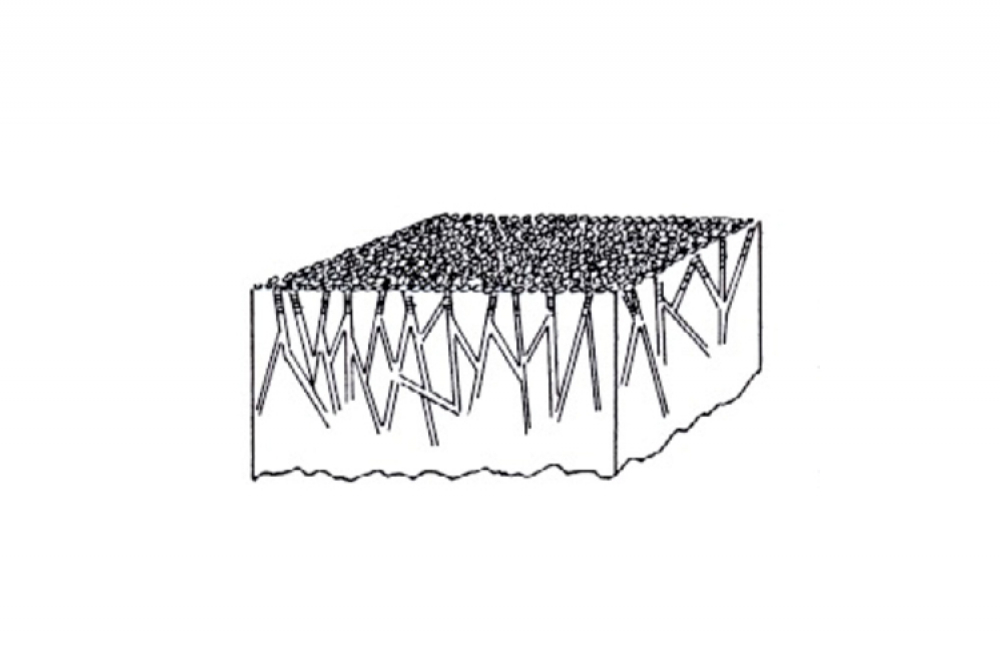
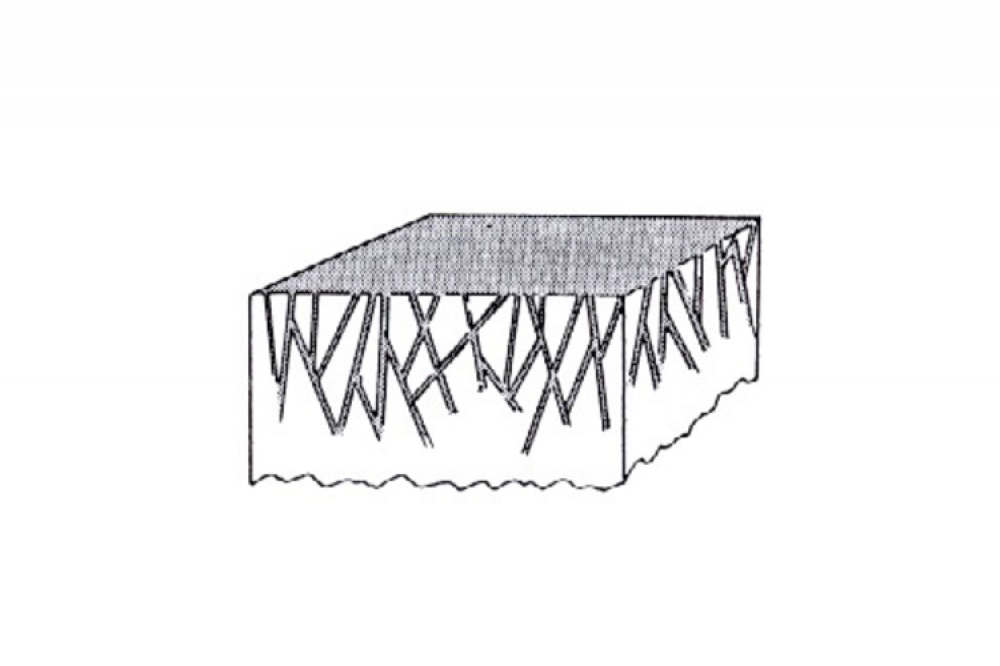
The essential difference between aqueous and solvent impregnations is the form of the binder. With aqueous impregnations, the binder is in the form of particles distributed in the water; it is therefore important that the particle size is kept to a minimum, to ensure the binder particles penetrate deep into the substrate (see Images 2 and 3).
Image 2: The binder has too large particles, so it forms a film on the surface.
Image 3: The binder has penetrated deep into the substrate, so there is no film on the surface.
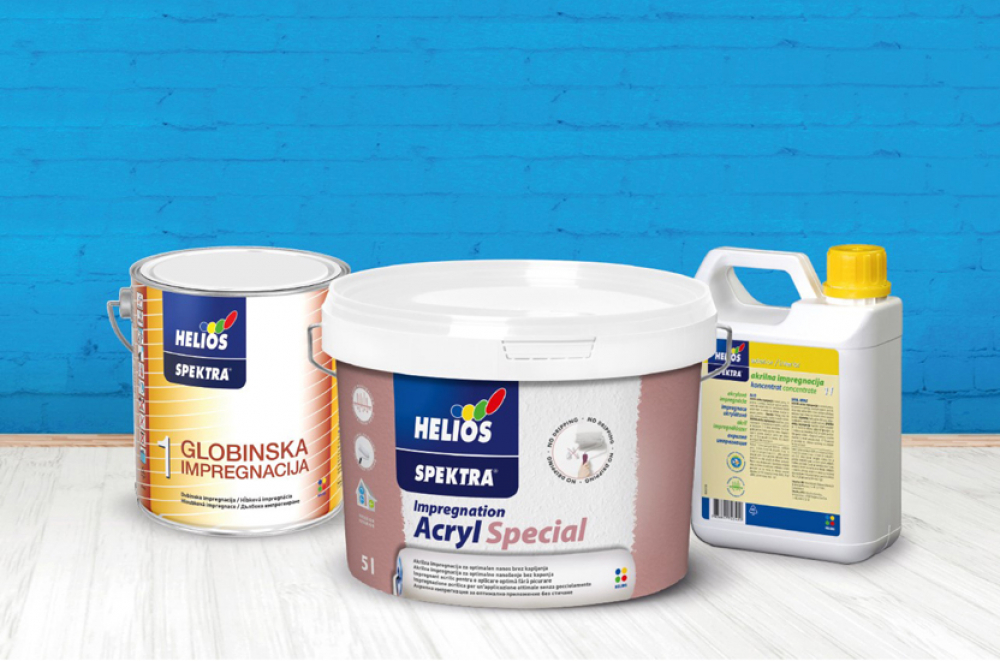
With solvent impregnation, the binder is dissolved in the solvent, enabling it to penetrate deep into the substrate. SPEKTRA deep impregnation is one such product.
Transparent impregnation is most often used for porous, chalking and highly absorbent substrates. Pigmented impregnation is used to achieve uniform absorbency, good adhesion, partial colouring and a uniform final colour tone in one step. For good adhesion of new coatings to smooth and non-absorbent old coatings, such as decorative techniques, choose a pigmented impregnation with good coverage, whose structure will ensure good adhesion of the new coating. SPEKTRA DECOR grund meets these requirements.
To improve adhesion to smooth concrete and to factory-prepared concrete substrates, use coarse, binder-rich, partially pigmented primers, such as SPEKTRA primer.
Which impregnation to choose?
Choosing between solvent and aqueous impregnations largely depends on the properties or quality of the substrate. In general, solvent impregnation is used in the case of extremely absorbent, chalking or very smooth substrates. Due to the solvent base, avoid use on interior wall surfaces for environmental and health reasons. Solvent impregnations do however, bind the substrate more strongly and also penetrate deeper than acrylic ones. Due to capillary action, small particles of binder in acrylic impregnations penetrate the substrate, but with chalking substrates, water evaporates very quickly as a means of transporting the binder, which prevents the binder from penetrating sufficiently into the substrate. It consequently forms a separating layer, which results in poor adhesion of the next coating. If correctly selected and diluted according to the instructions, the impregnation should not form a film on the surface once dry (see Images 2 and 3).
In the case of façade paints and façade thermal insulation systems, the correct choice of impregnation is also very important due to the desired properties of the coating, especially the system’s vapour permeability. With silicone façade paint and silicone plasters, we therefore recommend the use of SPEKTRAsilicone impregnation, as it has a similar composition to the binder and maintains the system’s vapour permeability.
It is also important to know the composition of the thermal insulation system. If styrofoam is used as insulation, solvent-based impregnations should not be used for repairs, as the styrofoam may become soaked.
With silicate coatings, silicate impregnation is mandatory, as due to the specific hardening (silicification) it must not reduce the reaction of water glass with silicates in the substrate.
SPEKTRA impregnations
Systemic use of impregnations
Each paint manufacturer lists systems, meaning they recommend the appropriate impregnation for a particular type and quality of substrate and for the selected coating. Due to the complexity of the substrates and coating properties, the systems are listed in the technical information according to the type of substrate and choice of final coating.
The application of an impregnation follows immediately after any repairs of damage and/or mould. Only then may fine levelling with leveling compounds and final painting be carried out.
Transparent impregnations are usually very liquid. We therefore recommended applying them with a brush, to minimise the loss of material due to intense dripping. When applied with a roller, a lot of impregnation is lost due to spraying. The user is also exposed to the spraying and must be suitably protected.
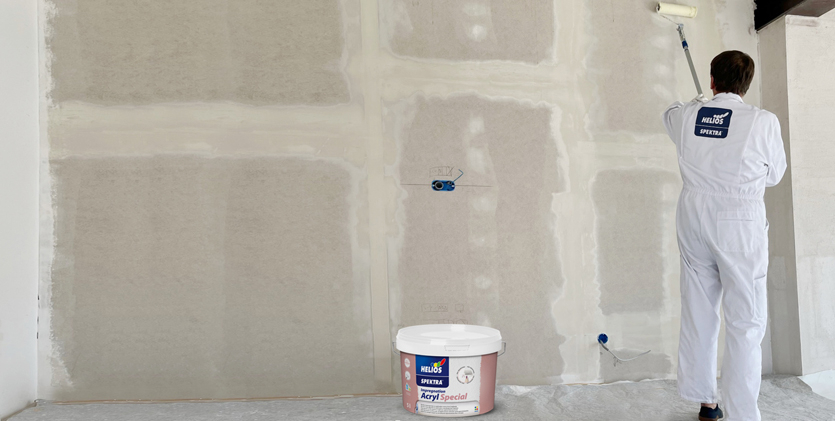
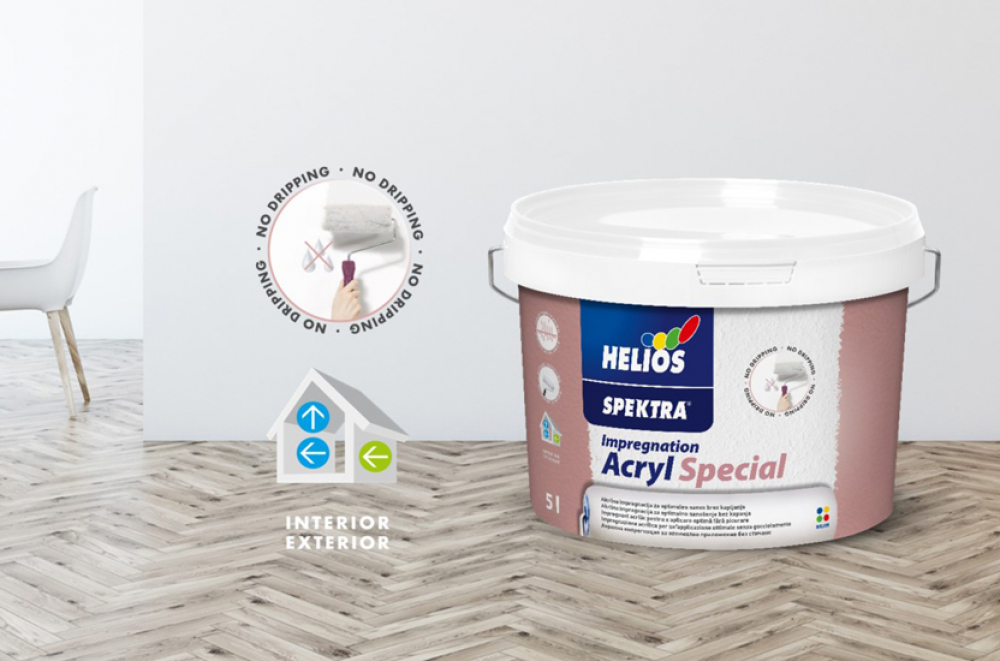
At HELIOS, we have added the new SPEKTRA Impregnation Acryl Special to the family of transparent impregnations, whose main feature is its application with a roller without dripping. The impregnation is very similar in appearance to conventional impregnation; it behaves like normal liquid impregnation when mixed, and does not run or drip during application.
Dilution is not necessary before use, as it nevertheless penetrates deep into the substrate, binds old coatings and unifies the substrate’s absorbency. The impregnation’s yield is comparable to that of conventional impregnations, as 1 l coats 15 – 25 m² of surface, depending on the substrate’s roughness and absorbency. It is suitable for the impregnation of interior and façade wall surfaces.