Advantages od roof protection with flexible waterproof polyurea
Advantages od roof protection with flexible waterproof polyurea
29 March 2024
Roof waterproofing is crucial for the durability of a building. Suitable waterproofing can extend the service life of the roof and protect the building from weathering. Polyurea is a liquid-applied membrane, most highly valued in situations where the speed of application as well as mechanical and chemical resistance are of the utmost importance.
Among the various waterproofing technologies that have emerged in recent years, the use of polyurea membranes, a versatile and durable material, offers numerous advantages over traditional liquid membranes.
Advantages of flexible polyurea for roof waterproofing
It stands out for its remarkable drying speed. Unlike traditional waterproofing liquid membranes, which require hours or even days to dry, the Polyurea Flex coating cures within seconds to minutes after application. The fast curing time enables speedier project completion and allows for the building to be brought back into use quickly, which is especially useful in industrial and commercial environments where stoppage of work is a cost-related issue.
The material creates a seamless and flexible membrane which adapts to the shape of the roof, removing seams and joints which could be potential weak points for water penetration. It can stretch (more than 400%) and shrink with the substrate as well as adapt to displacements due to changes in temperature or other dynamic forces. It is suitable both for new buildings and the restoration of existing buildings.
Durable and long-lasting protection
The durability of the flexible polyurea membrane is another of its advantages. It creates a dense, seamless membrane with high tensile strength and tear resistance. This allows it to withstand significant wear and tear. Due to its chemical composition, it is resistant to wear and tear, impact and corrosion, which ensures long-lasting roof protection.
It is extremelly resistant to a wide range of harsh conditions. This makes it an excellent choice for difficult applications. Its superior temperature resistance allows for efficient operation in both extreme heat and cold. It is also resistant to various chemicals, including solvents, oils and salts. This makes it especially suitable for use in industrial environments where such exposure is unavoidable.
Environmentally friendly and safe
It is an environmentally friendly and safe material which does not contain any volatile organic compounds (VOC) and does not produce harmful emissions during application. Once reacted and cured, the material is inert and does not emit any substances. However, the application itself still requires the use of special protective equipment and caution, as inhalation of small particles can occur due to the machine application of the hot material under pressure.
Suitable for different roof types
It can be used for the waterproofing of different roof types, including flat and low, metal, concrete and sloped roofs. It fills cracks and joints in roofs, providing a completely waterproof layer.
How does KANSAI HELIOS Polyurea Flex work?
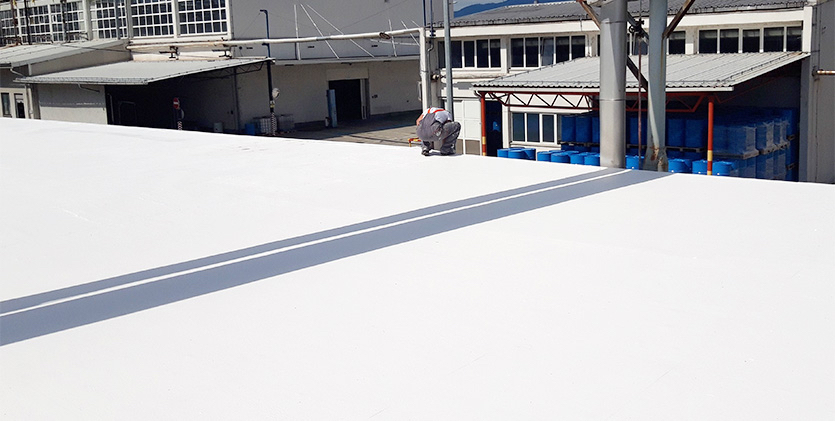
POLYUREA FLEX is a two-component liquid membrane, applied to the roof surface with a special high-pressure machine or reactor. The application temperature of both components should be ~+70 °C. The two components, resin and isocyanate, are mixed under high pressure, sprayed onto the roof and react with each other (in 30-40 seconds) to form a seamless waterproof membrane that is walkable and waterproof in a very short time (approx. 1 h). Application in two thin layers of a total thickness of 2 mm is recommended. The second layer should be applied perpendicularly to the first. If the membrane has been exposed to UV rays, apply PAS TOP COAT 450 - a UV-resistant aliphatic polyurethane topcoat - as the finishing coat.
Factors that can affect the efficiency of polyurea waterproofing:
appropriate preparation,
temperature,
humidity and
type of substrate.
Appropriate preparation of the surface is essential to ensure adhesion and prevent delamination. The ideal application temperature range is between +5 in +30 °C and humidity should be below 85%. Use an appropriate primer for substrate preparation. The choice of appropriate primer is influenced by the type of substrate:
concrete substrate ~ primer EP 430,
metal substrate ~ primer EP 430,
bitumen ~ primer PU 420.
Although polyurea is generally more expensive than traditional roof materials such as bitumen, PVC, etc., it is still a good investment due to its long-term benefits and savings. Its fast installation, flawless use and resistance to extreme weather conditions make it a favourite choice for owners and managers of commercial and industrial buildings. With proper maintenance, such a system has an expected service life of 25 years, reducing ongoing repairs and the costs of maintenance.